
Drone-based facade inspections in hospital settings: protecting patient privacy

Hospitals cannot put off critical inspections of their facades indefinitely. These buildings must be assessed, maintained, and secured. But as soon as drones enter the picture, a legitimate question arises almost immediately: how can we obtain the necessary technical information without causing unnecessary anxiety for the patients inside?
In a hospital setting, privacy is not a minor detail. It directly affects patients’ dignity, comfort, and sense of security, often at a time when they are already in a vulnerable situation. That is why the right approach is not to downplay this concern, but to address it openly: explain what the drone actually sees, explain what the final deliverable actually contains, and, above all, establish the right protocols before the drone even arrives at the hospital.

Why is this concern legitimate?
This concern is legitimate. In a hospital, privacy is not a secondary or abstract issue. It directly affects the patient’s dignity, comfort, sense of security, and trust in the facility providing their care. When a drone is scheduled to fly near a building facade containing patient rooms, waiting rooms, or other occupied spaces, it is natural for questions to arise.
The wrong response would be to dismiss this concern. The right response is to acknowledge it and then address it with facts, a clear approach, and concrete preparatory measures. In a hospital setting, privacy isn’t just about the technology used. It also depends on how the inspection is planned, explained, and managed.
What the drone actually sees during a facade inspection
During a facade inspection, the drone is not used to view the interior of the building. It typically flies parallel to the building envelope, with a camera pointed at the facade to document materials, joints, cracks, movement, and other elements relevant to the facade inspection. In most cases, the image primarily captures the building’s exterior surface as well as reflections in the glass.
It is important to be precise about the operating distance. Drone operations for facade inspections are generally conducted at a distance of approximately 4 to 10 meters from the building. At this distance, even though partial visibility through certain windows may sometimes occur, depending on the angle, the transparency of the glass, and lighting conditions, it is generally impossible to make out significant interior details. The camera required for the inspection focuses on the facade, not on what lies inside the rooms. The significant difference in brightness between the exterior and the interior spaces, which are usually darker, further reduces the visibility of the interior.

The distance between the drone and the building facade varies depending on the level of detail requested by the client.
Why the final deliverable is a game-changer
It is also important to understand that the final deliverable of a drone-based facade inspection is not simply a series of isolated raw photos. In many cases, the result delivered to the client takes the form of a photomosaic or an analytical composite created from a large number of images. This process serves to document the building envelope in a coherent and actionable manner for analysis.
In other words, what matters for the inspection is not a single image taken out of context, but the overall assessment of the facade. This distinction is important because it minimizes the relevance of vague or incidental details that might appear in a raw image. And if a potentially identifiable element remains visible, additional measures can be taken before final delivery.

Raw image from the drone
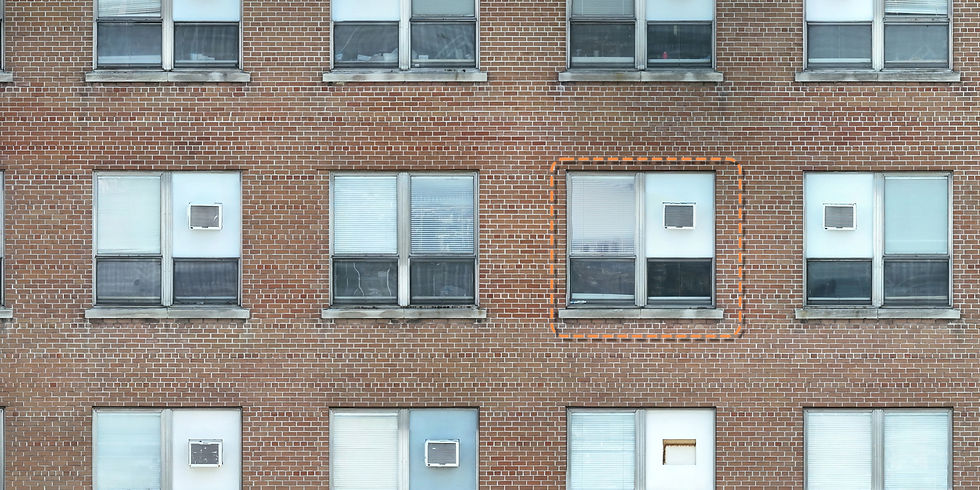
Assembled orthomosaic
There is an option to blur certain details in the rare instances where patients are visible through the glass.
The real privacy issue begins before the flight
The best way to protect patient privacy is not to improvise once the drone is already flying past the windows. It involves laying the groundwork in advance. In a hospital setting, proper preparation minimizes surprises, reduces stress, and allows on-site teams to respond calmly and effectively.
In other words, privacy protection doesn’t depend solely on the pilot or the flight path. It also depends on the hospital’s ability to inform the right people at the right time, prepare the relevant units, and coordinate the simple measures that make a real difference before operations begin.
What can hospitals do in advance?
01 Appoint a hospital-side coordinator
A clearly designated individual should handle internal coordination during the inspection window. This person can confirm the affected areas, verify that notifications have been sent, address last-minute issues, and serve as the point of contact between the clinical team, the technical team, and the field team.
02 Inform head nurses to ensure the message actually reaches the wards
A general email is helpful, but it is not always enough. If head nurses mention the operation during shift handoffs or brief team meetings, the information is much more likely to be effectively relayed to patients and the staff involved.
03 Provide a clear notice to patients
Patients should not be caught off guard by the drone’s presence. A brief notice written in simple language can explain why the inspection is taking place, what the drone is actually observing, and what measures for comfort or privacy are available during the operation.
04 Close blinds or curtains in advance in targeted areas
In certain more sensitive units, it is best not to rely solely on occupants’ spontaneous reactions. The hospital can arrange for the preventive closing of blinds or curtains during the targeted period, then reopen them once the area has been inspected.
05 Notify the team responsible for patient experience or patient relations
When a patient or family member raises a concern, it’s best to have a team ready to provide a clear response. This prevents conflicting messages and helps maintain a climate of trust during operations.
06 Send a reminder on the day of the inspection
A notice sent several days in advance sets the stage, but a reminder on the day of the inspection helps teams take action at the right time. A short message sent to the relevant units may be enough to remind them of the planned sequence, the targeted areas, and the simple steps to take before the drone flies over.
07 Prepare a short FAQ
A concise FAQ helps standardize communication across the hospital. It can answer a few simple but important questions, such as the reason for the inspection, what the drone actually captures, the options available for privacy, and who to contact if there are any concerns.
Privacy is not just a matter of flight, but also of communication
In many cases, the concern stems less from the method itself than from the element of surprise. When a patient, staff member, or family member spots a drone without having been informed in advance, the natural reaction is often confusion or concern. Conversely, when the context has been clearly explained, the same procedure is much easier to understand and accept.
That is why a respectful inspection relies not only on technical parameters. It also depends on the quality of communication surrounding the operation. A simple, consistent, and human message can significantly reduce the perception of risk and improve the experience for everyone involved.
A respectful process protects both people and the project
Hospitals need reliable data to assess the condition of their facades, plan maintenance work, and safely maintain their buildings. But these technical objectives should never be separated from the human reality of the hospital environment. Behind every window, there may be a patient, a family, a staff member, or a sensitive situation that deserves to be handled with tact.
A well-prepared approach allows us to balance these two requirements. It enables a thorough inspection of the building envelope while minimizing avoidable sources of stress, surprise, or discomfort for occupants.
Conclusion
The goal is not merely to conduct an effective facade inspection. It is to do so in a way that respects patients’ dignity, minimizes surprises, and takes into account the reality of the building in use. In a hospital setting, technical rigor and human sensitivity must go hand in hand.
When a drone inspection is clearly explained, properly supervised, and well-prepared before flights even begin, it becomes possible to obtain the necessary information without losing sight of what matters most. The building must be inspected, of course, but the people who occupy it deserve just as much respect.


Comments